


Submitted by MNTO Contributor, Hongyu Xiao, for MNTO Gigs
“Growth should pay for growth” has been one of the most consistent mantras from politicians and planners alike for the past few decades. In theory, the idea seems benign, even uncontroversial. Since infrastructure is needed to support housing construction and development, it seems only fair that developers and not municipalities should bear the associated costs. In practice, this has led to the explosion of what Mike Moffat from the Missing Middle Initiative calls the “alphabet soup” of fees and taxes that municipalities levy on new development – from outright development charges to community benefit charges, parkland dedications, and so on.
At the core of this thinking is the belief that new development, and growth generally, is a burden that has to be managed. While there is no denying that there are costs associated with growth, those costs have to be balanced against its very real benefits – not just to new residents, but to incumbents as well. With housing starts in free fall and construction grinding to a halt, the “free lunches” from housing development that municipalities have relied on in the past decade have come to an end. The time is ripe for us to rethink our approach entirely and recognize that we should all support growth.
Growth is good
First, it is worth considering how and why cities grow. In Order Without Design, Alain Bertaud observed that cities are primarily labour markets. In particular, he argued that the efficiency of large labour markets is the main cause of ever-growing cities. Robust job markets enable all the major amenities of the city, by bringing together people with varied but complementary knowledge and skills. This enables innovation and the creation of varied attractions like restaurants, art galleries, public libraries, and well-designed public spaces. These amenities in turn require specialized jobs and attract an even more diverse population, which drives further innovations and an interesting urban fabric.
Growth does not just benefit newcomers; it also benefits existing residents. A productive labour market increases salaries and provides more job opportunities for everyone. More urban amenities are enjoyed by all residents, new and old alike. An expanding tax base allows the city to reduce the individual tax burden and also provide more services. Increased population growth can also increase property prices, which raises affordability concerns but generally benefits incumbents.
It is also worth noting that not all population growth is from immigration. Some population growth is natural ageing as children grow up and set up their own homes but want to remain close to friends and family. Internal migration – often young people leaving smaller towns or cities to pursue job or social opportunities in bigger cities – is a positive phenomenon that encourages economic mobility and dynamism. Studies in the United States show that counties with the highest in-migration per capita experience the highest wage and business growth,1 while young workers experience meaningful wage increases after moving to places with better jobs.2
Bertaud points out cities grow organically, in response to market forces. Therefore, attempts to control a city’s growth are usually misguided at best or destructive at worst. The only way to slow population growth is if the city becomes a worse place to live, either by becoming too expensive or losing economic value. In the worst case scenarios, population loss can lead to a death spiral, as many cities in the American Midwest and Northeast experienced in the mid-1900s.
Reducing immigration is not a good way to reduce population growth in cities. As the experience of Japan shows, stagnant population growth does not reduce the attraction of cities. In fact, it hollows out smaller towns and makes the metropolis, as the one place where people do go, even more popular.
How do we enable growth to succeed?
Growth is not automatically good. More people does mean increased demands on existing infrastructure. The lack of proper supports – especially in housing, transportation, schools and parks - can mean a worse experience for incumbents and newcomers alike. Infrastructure needs to be built to support that growth.
The “growth pays for growth” model has imposed the costs of that infrastructure squarely on the shoulders of developers. As the Missing Middle Initiative has noted, cities across Canada, but especially in Ontario, have significantly increased development-related charges over the past decade, often at multiples much higher than inflation. These charges come in multiple guises, either as outright fees, as “community benefit charges,” parkland dedication, and so on. This is particularly acute in Toronto, which charges by far the most per apartment unit across all municipalities in Canada.3
There are several issues with this model, including the fact that a substantial amount is unspent (almost $3.1 billion in Toronto).4 This article focuses on two key problems: (i) the fact that the actual tax burden falls on new entrants into the housing market, and does not truly fall on developers, and (ii) that development charges prevent construction of the housing types we say we want.
First, it is common to see development charges described as a payment that “developers” have to make. This is not accurate. While developers legally must pay the charges, to the extent that they are able to pass these costs down, the effective burden of the charges falls on the ultimate purchaser of the house (either the homebuyer or renter). In this regard, development charges are like any other tax. To take one example, if the government were to increase taxes on tobacco sellers by one dollar (the legal burden), and retailers responded by increasing the prices of cigarettes by one dollar, then the economic burden of the tax is on the consumer who pays the higher price. The legal burden of the tax (who legally makes the payment) is irrelevant to the actual burden.
A common objection to reducing development charges is that developers will simply pocket the profits. This is misguided. Reducing development charges allows the market to operate to reduce rents and prices (as is happening in cities across Canada and in the United States that allow homebuilding). If development charges remain high, developers will not reduce their prices beyond the costs they have incurred. Reducing costs allows prices to fall.
Second, a common complaint is that developers fail to build enough “family-sized units” and build too many “shoebox” apartments. While part of this is in response to investor demand (or had been), the fact is that development charges make it twice as expensive to build 2+ bedrooms than to build studio units. It is hardly surprising that developers should prefer to build more studios when each unit costs $52,676 and each 2 bedroom costs $113,938. We prevent the construction of the housing types we say we want.
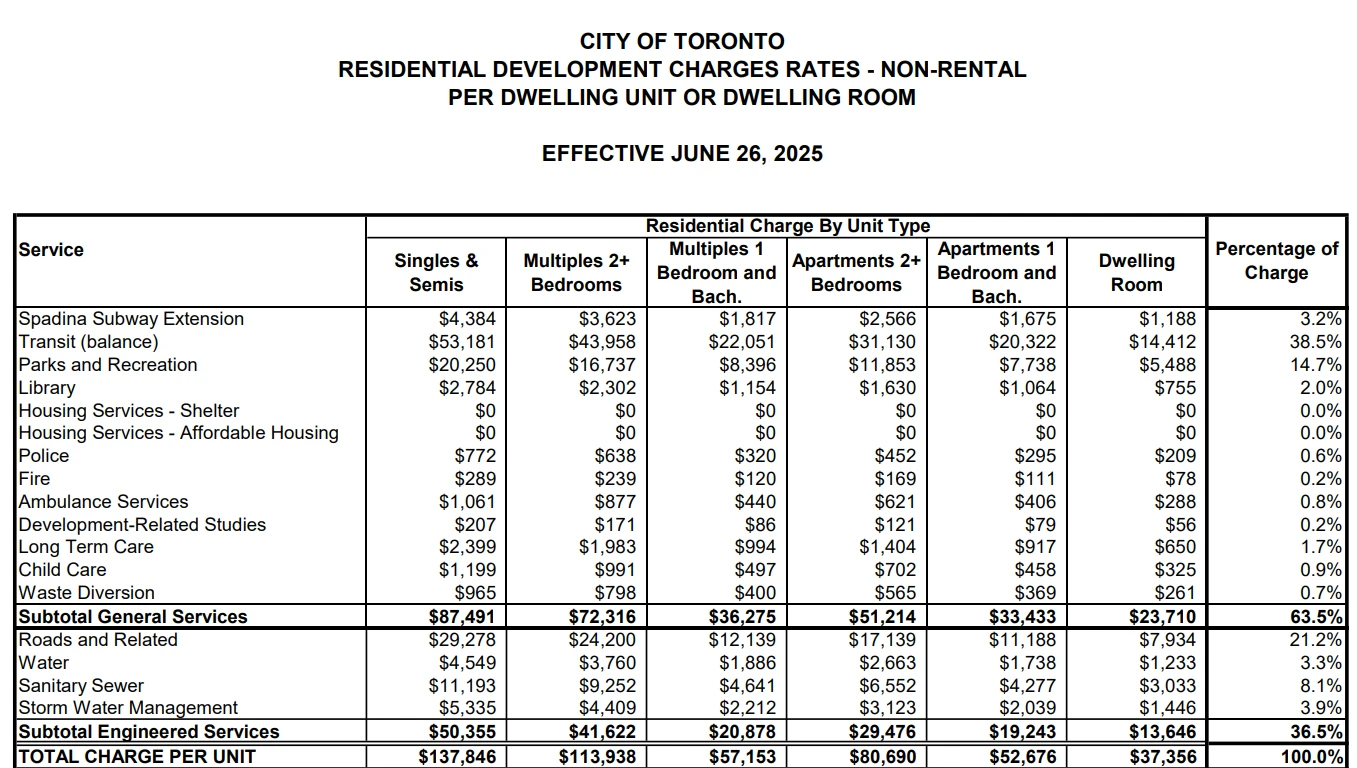
Source: https://www.toronto.ca/wp-content/uploads/2025/08/9709-DC-Rates-June-26-2025.pdf
The real question, therefore, is not whether developers should “pay for growth,” it is whether new homebuyers or renters – the people who want to move into new housing – should “pay for growth.” When everybody (including incumbents) benefits from population growth, it is fundamentally unfair and harmful for new entrants to disproportionately bear the burden of these costs.
Density maximizes the benefits of growth
Cities work because – and when – they are places where people can live and work. People are the foundation of a city’s success. That success attracts more residents, who contribute to the wellbeing of all residents by being potential friends, dates, consumers, employers, workers, and taxpayers. To achieve that success, infrastructure must be built that can support and accommodate that growth. Given that population growth has broad-based benefits, support from that infrastructure should also come from the population at large.
While this means support through property taxes and other levels of government, it does not necessarily have to mean tax increases. Increasing densification around transit areas and in Toronto’s older neighbourhoods can support population growth without necessitating substantial infrastructure investments, since many of these neighbourhoods have lost population since the 1950s and already have access to substantial amenities. For example, the area around Palmerston Boulevard is near many excellent parks, schools, and transit, but has lost half its population (12,000 to 6,000) since the 1960s. These are prime areas for intensification.
Increased population and density can widen the tax base by increasing the number of property owners, reducing the overall tax burden on Toronto’s residents. Densification helps first-time homebuyers without hurting long-time homeowners. Densification near transit stations also means that population growth does not have to add to the number of cars on the road, reducing the impact on congestion while supporting transit ridership. The increased fare revenue can then feed into system improvements, creating yet another virtuous cycle of infrastructure development.
The City of Toronto is currently engaging in a review of development charges, which is expected to be brought before Council in the Spring of 2026. This is a prime opportunity for us to find ways to spread the “costs” of growth, so that we can all share in its benefits equally.
1 https://www.thirdway.org/report/stuck-in-place-what-lower-geographic-mobility-means-for-economic-opportunity
2 https://www.ssa.gov/policy/docs/ssb/v80n2/v80n2p1.html#:~:text=Through this mechanism, geographic mobility,(with or without relocating)
3 https://www.cmhc-schl.gc.ca/observer/2025/we-built-this-city-development-charges
4 https://www.missingmiddleinitiative.ca/p/why-is-toronto-hoarding-infrastructure