


More Neighbours Toronto is tracking the milestones that the City of Toronto committed to in its Housing Accelerator Fund (HAF) agreement. A previous evaluation of HAF progress from December 2024 explains what the Housing Accelerator Fund is and how we evaluate progress. This update explains progress and setbacks in 2025.
Housing Accelerator Fund background
The Housing Accelerator Fund is a federal government program where municipalities submitted applications committing to process, zoning and other reforms in exchange for federal funding. You can view Toronto’s signed agreement here and a preliminary version of their application here. Municipalities proposed multiple initiatives, but with three key points in mind:
-
Initiatives should produce new housing supply, as measured by additional building permits issued above historic averages. Toronto committed to producing a total of 60,980 permits during the 3-year period of the HAF.
-
Initiatives should have an impact on the housing system, not just individual projects. In general, the changes that municipalities proposed should be broad reforms or long-term commitments that would continue to accelerate housing and/or increase housing supply after the HAF program ended.
-
Funding would be delivered in four separate advancements with the understanding that later installments could be withdrawn if municipalities did not meet the commitments they made. Toronto’s first advance of $177,777,490 (a quarter of the $471 million Toronto was awarded for the commitments in their agreement) followed the passage of the agreement text by Toronto City Council in MM13.27. The second and third funding advances were to be based on meeting the milestones in the agreement. The final advance would depend on meeting the building permits targets in the agreement.
What happened in 2025 - summary
As of December 31, 2025, Toronto has completed 20 of 29 milestones that were scheduled to be completed by this date. Only 13 of these milestones were completed on time. Another 6 milestones have later due dates and two of these have already been completed ahead of schedule (milestone 3.5 - the pre-development fund, milestone 6.2 - implementation of Rental Housing Supply Incentives program through first call for applications). One milestone that was listed as completed on time in 2024 was revised to completed late in 2025 because a second rezoning was needed to advance the project (milestone 5.2 - Quayside rezoning).
| HAF Initiative Description | Est. additional permitted units (3 yrs) | Milestones completed | Milestones due by Dec 31, 2025 | Total Milestones in Initiative | Milestones that were completed on time |
| 1. Transforming the City of Toronto's administrative structure and increasing capacity to expedite the approval of new development applications | 700 | 6 | 6 | 6 | 6 |
| 2. Revitalizing Toronto Community Housing Buildings and Creating Net New Rent-Geared-to-income and Affordable Rental Homes within inclusive, equitable and complete communities | 2600 | 2 | 3 | 3 | 1 |
| 3. Protecting Rental Homes and Increasing Affordability for more renters | 0 | 3 | 4 | 5 | 2 |
| 4. Enhancing the Housing Now Initiative and expediting delivery of new permanent affordable rental and RGI homes within transit-oriented and complete communities | 3200 | 2 | 3 | 6 | 1 |
| 5. Transforming Toronto's Waterfront as a catalyst for social, economic and cultural growth | 880 | 2 | 2 | 3 | 1 |
| 6. Implementing a new 'Rental Housing Supply Incentives' Program to increase purpose-built rental housing supply | 3100 | 2 | 1 | 2 | 2 |
| 7. Expanding missing middle housing options and allowing increased density | 700 | 4 | 8 | 8 | 2 |
| 8. Optimizing land use and simplifying the planning approvals process to increase purpose-built rental supply in Apartment Neighbourhood zones | 600 | 1 | 2 | 2 | 0 |
| Totals | 11780 | 22 | 29 | 35 | 15 |
We had previously categorized milestones as “Not started”, “In progress” or “Complete” but, in 2025, we added an “Incomplete” category for milestone 7.3 when Toronto City Council voted against implementing a citywide sixplex by-law. This prompted a letter from federal Minister of Housing Gregor Robertson, stating that “the June 25 Council vote goes against the level of ambition that was committed to in our Housing Accelerator Fund Agreement by the City of Toronto” and asking the City to revisit measures that they could use to address the housing crisis because he could “make no compromises when it comes to the integrity of the program.”
Mayor Chow responded with her own letter, outlining a number of changes that Toronto has made to address the housing crisis. However, the majority of the items that she lists are already part of other HAF milestones. They therefore cannot be considered as replacements for the sixplex milestone since the new housing produced or accelerated by those other changes would already have been included in the commitments that Toronto made and will receive funding for.
We will examine individual initiatives in the next section, but it is worth examining the letter’s claims about housing starts here. Mayor Chow claims that “We’re getting shovels in the ground, more than anyone else in the country.” This is false, even in absolute terms, let alone when accounting for Toronto’s larger size. At the time of the mayor’s letter in July 2025, CMHC (which records starts by metropolitan area, an area larger than the City of Toronto), recorded 14,295 starts for January-July 2025 in Toronto, a 50% drop from the previous year. In the same period, Calgary had 16,601 starts and Vancouver had 15,879. The mayor is correct that the market had a downturn, which affected both private market and affordable housing projects, and Toronto is doing better than many other places in Ontario, but Ontario is lagging far behind other provinces.
In addition, the letter says “At the end of 2024, after the first year of implementation of HAF, the City of Toronto had delivered on 37.5% of the three-year target.” While this was roughly correct at the end of 2024, when Toronto had 20,999 starts, housing production worsened in 2025 and the 2024 information was already out-of-date when the mayor wrote her letter. Toronto’s Housing Dashboard lists 11,316 new homes created from Jan 1 - Nov 30, 2025. These 32,315 homes put Toronto at 53% of their target when 64% of the HAF time has elapsed (23 of 36 months), although technically the HAF measurement will be made using building permits issued rather than construction starts. This would mean that the City is behind target, which is understandable given the market downturn, but means that it is difficult to point to housing starts as an alternative reason for Toronto to receive funding instead of milestone completion.
There are, however, two changes in the mayor’s letter that are not part of existing HAF milestones that could be considered by the Minister. Firstly, while changes to Major Streets were in the HAF agreement, the initial milestone only committed to permitting 30 units in an apartment, whereas the City passed the item with an increased 60-unit cap. Secondly, the mayor supported and expanded on Councillor Myers’s July 2025 motion MM32.5 to exempt 5- and 6-plexes from development charges and parkland dedication.
In addition to the summary chart above and the breakdown in the next section, you can find analysis of individual milestones in our detailed tracker spreadsheet, which has separate tabs for tracking the milestones and summarizing the initiatives.
Progress and setbacks by initiative
In our December 2024 HAF tracker update, we evaluated whether initiatives were likely to produce new units beyond what the City had planned without HAF funds, how Toronto's initiatives compares with other cities, as well as whether changes were systemic and likely to continue to increase housing supply into the future. Those evaluations remain the same. In this update, we focus on the progress toward completing each initiative.
Although the housing market was affected by federal immigration changes and interest rates, there is a great deal of variation across the country. Starts have increased in many other provinces but Ontario remains behind. Toronto has seen cancelled projects and fewer proposals not just in the private market, but in ways that affect its own City-led housing plans. This makes it all the more important for Ontario municipalities to re-examine their policies and fulfill the commitments that they made in their HAF agreements.
Sixplexes were the most high-profile incomplete HAF milestone, but our count shows that there are 8 other milestones that are behind schedule and more at risk of not being completed. Here is a breakdown by initiative:
1. Expedite Development Review
Toronto created a new Development Review Division in an attempt to better co-ordinate the review of development applications across divisions. This appears to have been more successful than previous attempts to speed up the approvals (eg. Concept 2 Keys). The City has also implemented new electronic tools for application submission and a new file circulation tool that allows commenting across divisions was piloted starting Q2 2024 (noted in the October 2025 HAP updated Work Plan).
The mayor’s letter claimed that approval timelines are 80% faster, but this has been disputed by third-party planners. The evaluation is complicated by provincial penalties that were introduced in Bill 109 then removed in Bill 185, as well a reduced number of applications submitted in 2023 and 2024 relative to previous years. Part of the City's response to Bill 109 was to remove the ability to submit zoning and site plan applications concurrently, which decreases the time from submission to approval for site plan applications but does not necessarily improve overall time for the full application process. This also resulted in a higher rate of site plan application rejections while the system adjusted.

Applications submitted to Toronto City Planning by month. Source: City of Toronto Development Pipeline Report for 2024
Nevertheless, a BILD report found that even pre-Bill 109 approval times had been reduced from 32 to 25 months and the post Bill-109 decreases are significant enough to suggest that there have been further improvements since then. There is a concerning trend of increasing timelines for decisions in recent months, possibly the result of an uptick in submissions from the 2024 low, or possibly related to the removal of financial penalties in Bill 185. (Note that the sources for post-Bill 109 data below report the average for the entire time period from July 1, 2023 to the report date, meaning that decision times for the most recently submitted applications are even longer than this average suggests. For example, for the zoning by-law time to increase from 136 days for the July 2023 - May 2025 period to 169 days for the July 2023 - Dec 2025 period, the approval time for the 7 months between May - December 2025 would need to be much longer than 169 days.)
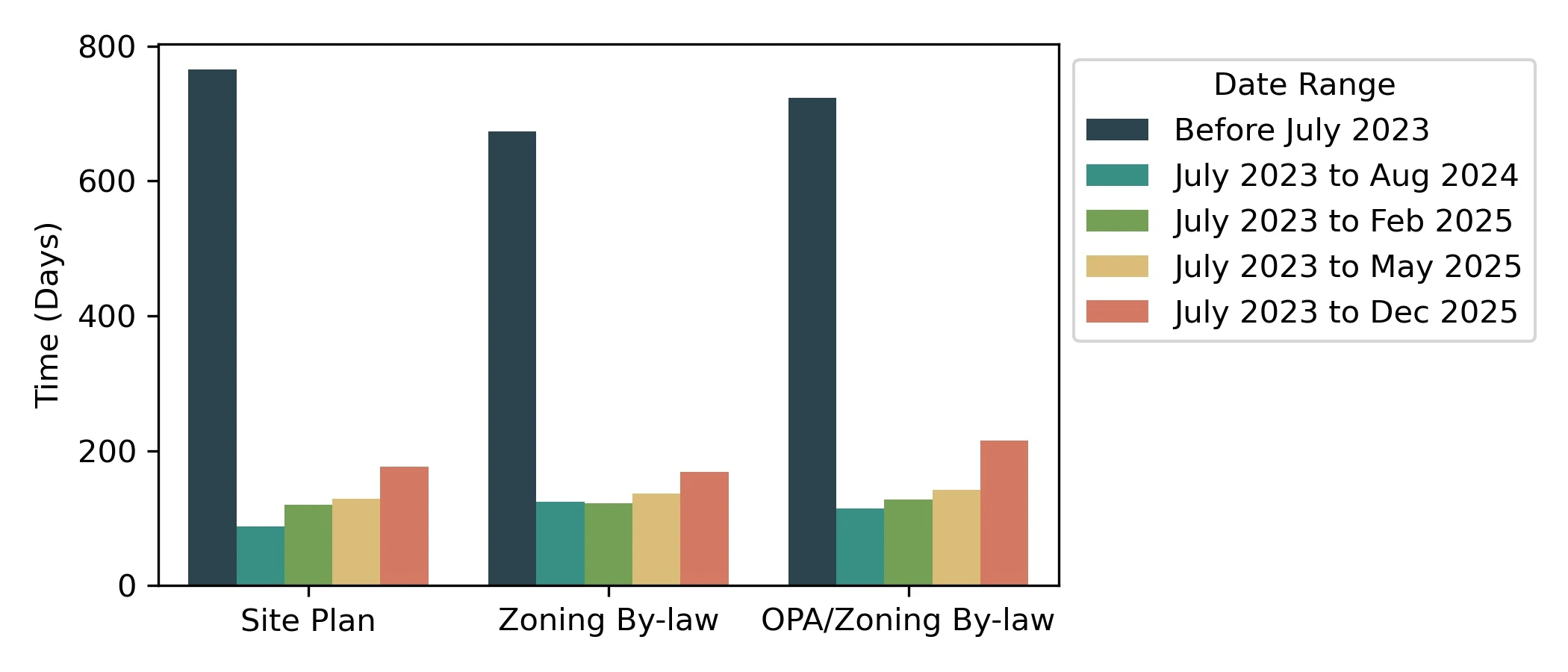
Decision review timelines for various applications to City Planning. Many aspects of the process changed following Bill 109, making comparisons before and after July 2023 difficult. Sources: Toronto Housing Dashboard (data from December 30, 2025) and Development Review Reports from Q2 2025, Q1 2025, Q4 2024.
In addition, the City has created a priority review stream for affordable housing, seniors housing and other priority projects so that they can get from application to construction in 12-24 months. We have observed applications in this stream that have been processed through to Council approval in about 130 days.
Finally, it is worth acknowledging the amount of useful data that Toronto has made available to track housing progress. Good public data is unfortunately rare in Canada, even at the provincial and federal levels where there are often more resources. Toronto has made its development pipeline data available through its Open Data portal. They have also created useful dashboards so that this information can be accessed more easily by the average resident (housing data, shelter data). This data does not always paint the City in a positive light and there have been numerous provincial changes and reversals that have altered data interpretation, but Toronto has continued to consistently post their data and be transparent about the effects of legislative changes, even tracking pre-application consultation times when they shifted some processes there. We cannot evaluate progress and hold governments accountable without good data and this HAF tracking report benefited from access to this information.
This is perhaps Toronto’s strongest initiative, with 6 of 6 milestones completed, all of them on time.
2. TCHC Revitalization
This initiative consists of large revitalization projects of Toronto Community Housing (TCHC) properties in Regent Park, Firgrove and Lawrence Heights that include new units. These projects are challenging, particularly in poor market conditions.
Regent Park completed rezoning last year with added density. Although the rezoning milestone was late because the rezoning had to be redone when it was discovered that the initial building footprint conflicted with existing City infrastructure, the added density and downtown location make this project more viable and more likely to advance even in a market downturn.
Unfortunately, the same is not true for Firgrove and Lawrence Heights. The Toronto Star reported that, despite a “housing ready” label, TCHC has been struggling to find a bidder to take on the full Firgrove site under the currently proposed plan. They proposed to split the site into blocks for separate bids, hoping that this would allow some parts of the project to advance initially and that the market would recover for building later on other parts of the site. Because the milestone only required the Draft Plan of Subdivision to be approved (which actually passed Council conditionally in July 2022, before Toronto’s HAF application was even submitted), its completion status is unchanged, but these delays mean that this project is unlikely to contribute new housing starts during the HAF time period.
Similarly, in December 2025, the Toronto Star reported that the City had been unable to find a development partner for Lawrence Heights because current market conditions did not support the planned revitalization. TCHC announced that it would attempt to proceed on its own under the City's new "public builder" model but has not released any additional information. The City does not have recent experience advancing projects through construction without a development partner and it is concerning that private and non-profit developers seemed to view the project as too risky to bid on as currently proposed. In addition, the project was not exempted from $800,000 in planning application fees, which had not been anticipated in the budget, which adds to the risk that this project will not advance and produce new units anytime soon.
Given this risk and the fact that the decision seems to have been made due to a lack of other options rather than because it was an economically viable option, we have not marked the milestone for selection of a development partner for Lawrence Heights as complete. This initiative therefore has 2 of its 3 milestones completed, but only 1 of them on time (and that one appears to have been done before HAF even started).
3. Protecting Rental Homes
Milestones 3.1 (report on a pre-development fund) and 3.2 (new MURA call for applications) were already completed last year.
Milestone 3.3 about establishing a Housing At-Risk Table is complicated. Last year, we reported that we couldn’t find any information about the Housing At-Risk Table beyond a mention in the 2024 Budget Documents. This year, thanks to a detailed submission from Melissa Goldstein on the Tenants’ Advisory Committee, it seems that Toronto has converted its previously-established Specialized Program for Inter-divisional Enhanced Response to Vulnerability (SPIDER) to the Situation Table for Housing At-Risk (STAR). However, Goldstein outlines the timeline and the ways in which STAR does not fulfill the City's commitment to establish a working group for a Housing At-Risk Table. Given some of the findings of the Ombudsman, particularly in the City's response to rooming house complaints, we’re inclined to agree that Toronto has not fulfilled this milestone, which is intended to provide a process to review complaints received and connect people to supports to prevent and reduce evictions. In addition, while the City has established a new renovictions by-law, we could not find evidence that they had created a new rental protection and supply team (milestone 3.4).
Finally, for milestone 3.5, Toronto put out a Call for Applications for its Community Housing Pre-Development Fund in November 2024. As noted in PH23.5, the Executive Director of the Housing Secretariat approved $16.9 million in loans for 13 projects. The City notes that it received no indigenous-led project applications (a group mentioned in the milestone for funding), but they set aside an additional $3 million in loans for such projects, so we have marked this item as complete, ahead of schedule.
Toronto has therefore completed 2 of the 4 milestones in this initiative that were scheduled to be completed by December 31, 2025 (only 1 of them on time), as well as an additional milestone that was completed early.
4. Housing Now and Transit-Oriented Communities
Toronto was struggling to get shovels in the ground on its Housing Now sites, even before the market downturn. Last year, 2 of the 3 sites that were scheduled to break ground had done so, but the third site, 140 Merton St., still has not started construction a full year later in Q4 2025. The most recent update on Housing Now notes that a softening rental and condo market may require additional benefits to get shovels in the ground. However, two other sites have started construction in 2025: 777 Victoria Park, which was delayed slightly for a minor variance at Committee of Adjustment; and 2444 Eglinton Ave. E, which the Star recently reported may be affected by delays in a land deal that was intended to fund part of the project.
In their initial submission, the City suggested that 14 sites could reach the permitting stage by September 2026. In addition to the 5 sites above, there are now 4 other projects that might advance to construction by the end of the 3-year HAF period. A proponent has been selected for 705 Warden and they were supposed to submit a Zoning By-law Amendment to add density in Q4 2025 but the Application Information Centre does not have any new documents as of December 31, 2025. The next most advanced projects are Bloor-Kipling Block 5 and Parkdale Hub, which are out for market offering, and 158 Borough, which is expected to go out for offer soon.
If all 9 of these projects break ground at their currently planned densities, they would total 6231 housing starts. However, HAF was not intended as capital funding for existing projects but to incentivize additional new units beyond existing planned projects. While many of these projects have added new units through rezoning, the majority of the units were planned prior to HAF. It seems unlikely that the City is on track to reach its HAF commitment for 3200 HAF-incentivized units from initiative 4 by the final funding installment of March 2027.
There has been good news on Major Transit Station Areas (MTSAs) and a more rules-based approach to transit-oriented development, similar to BC’s. In August of 2025, the Ontario Minister of Municipal Affairs and Housing, after a long delay that was not the fault of the City of Toronto, amended and approved Toronto's MTSAs. The new MTSA policy includes increased zoning permissions that depend on existing land use designation and distance from the transit station. This is slightly more complicated than BC's approach but will incentivize additional units near transit when the City updates its zoning. The mayor announced that Toronto would pass the implementing zoning within 1 year and City Planning released a Work Plan to achieve this. Given recent challenges in passing citywide sixplexes and Neighbourhood Retail, there may be political challenges to passing the implementing zoning by-laws, but the timeline would allow the City to meet this milestone despite provincial delays. In addition, Planning is working on a relatively ambitious plan for the Marlee-Glencairn area that includes PMTSAs that are yet to be submitted for ministerial approval.
Of the 6 milestones in this initiative, 3 were due to be completed by December 2025 and 2 of those have been completed, with one of those completed on time. Unfortunately, 2 of the remaining 3 milestones related to Housing Now look unlikely to be completed during HAF.
5. Quayside
There were no new milestones related to this initiative due this year. Unfortunately, milestone 5.2, which had been marked as complete last year with a rezoning of the site in July 2024 (PH15.5), was revised when the site came back for a second rezoning in December 2025 (PH27.5). The new zoning increases the number of total units (from 2811 to 2850) and affordable units (from 458 to 553) while maintaining a high proportion of 2+ bedroom units, including affordable 4-bedrooms. A holding provision remains in the zoning until stormwater servicing conditions are met. This milestone is now marked as completed but not on time since this will likely delay the project.
Two of this initiative’s milestones were scheduled to be completed by December 2025 and 2 have been completed, but only one of these on time.
6. Rental Housing Supply Incentives
There are no new milestone deadlines for this initiative and Toronto had already completed both milestones last year even though one is not due until 2026.
One interesting update from the HousingTO Action Plan report is that, of the 15 projects awarded incentives in exchange for affordable units, two started construction in 2025. This is a demonstration that “stuck” projects can be unstuck with reductions in fees and taxes, getting shovels in the ground and new units built, including affordable housing units.
7. Missing Middle
Toronto remains behind schedule on many parts of this initiative, not because of market conditions or economic challenges, but because of political setbacks and struggles at Council to pass the new housing permissions that they committed to in their agreement. Last year, Toronto had completed 2 of the 5 milestones that were due (only 1 of those on time). In 2025, Toronto has completed 4 of the 8 milestones due (only 2 on time).
Small apartment and townhouse permissions on Major Streets (milestone 7.1), passed in 2024, with an upgrade to a 60 unit cap for apartments. In contrast, after a promising start, mid-rise on Avenues (milestone 7.2) has become quite fragmented and difficult to track, split into several Work Plan items. The first of these to pass Council was 2024.PH16.1 in November 2024 with zoning by-law updates to permit as-of-right mid-rise heights and densities on Avenues and Mixed Use areas, as well as updates to the mid-rise performance standards removing the 45 degree angular plane requirement. A new Avenues Policy that identified new Avenues was passed following a more contentious debate in February 2025, PH18.5. The zoning implementation for this policy has been split into stages for different wards, the first of which was for Wards 9 and 11 and passed Council in December 2025, PH26.4, but this item removed several areas of new Avenues from as-of-right mid-rise rezoning due to concerns about heritage, proximity to employment lands or for unclear reasons. The most recent HAP Work Plan lists future expansion of CR and Mixed Use zones on Avenues as planned for Q4 2026 or later. We have marked milestone 7.2 as complete, but not on time, given that it only required new by-laws to be proposed for implementation, but did not specify the extent of the changes to be completed, so PH16.1 fulfills this requirement.
The sixplex report and implementing by-laws for citywide permissions in low-rise Neighbourhoods (milestone 7.3) came to Council in June 2025, PH22.4. Council amended this item so that the zoning permissions applied in the 8 wards of Toronto and East York Community Council, as well as continuing the sixplex pilot in Scarborough North. While some councillors attempted to claim that the sixplex by-law was a surprise to them, that a report was sufficient without passing by-laws, or that the suburbs should be exempted, the wording in the signed agreement between Toronto and the federal government that Council previously voted on and agreed to clearly states that a by-law for implementation "across Toronto" is needed, so we have marked this item incomplete. In addition, Toronto added another restriction onto its existing multiplex permissions, implementing a bedroom cap in June 2025, despite the monitoring data showing that multiplexes were producing the larger multi-bedroom units that the City claims it wants.
Milestone 7.4, the how-to guides for garden suites and multi-tenant housing, have been marked complete but not on time, based on the information and concierge service for multi-tenant housing providers described in PH26.3, and the FAQ and summary of zoning rules and regulations on the City’s website for garden suites. A more complete guide outlining the development charge deferral process, financing options, resources for condo-ization in a single document (the City’s website format with accordion section expansion is not ideal for searching or archiving) would be useful but this item has been marked as complete.
For milestone 7.5, an updated version of the mid-rise design guidelines removed angular plane requirements but replaced them with shadow policies. A draft of these policies was published on Planning's site for mid-rise design guidelines with the intention to report back on any modifications in 2025 but this report did not happen. In addition, the City does not appear to have conducted a detailed review of its "no net new shadow" policies. They continue to state that this policy is used sparingly in areas of high intensity development like the downtown core, but indications in community consultation meetings and reports are that the City often considers maintenance of existing levels of sunlight to be a greater priority than housing. A motion to consider how the new mid-rise design guidelines that replaced angular planes would affect financial feasibility and housing construction was voted down at committee. Our members have observed multiple requests to revise applications to reduce housing for shadows outside of the downtown core and new secondary plan proposals discuss the inclusion of policies to minimize shadow impacts. Unless the City is using some alternative definition of minimize, they do not seem to be reviewing their existing shadow policies beyond the removal of angular planes. We have therefore marked this milestone as still in progress and not on time.
Council adopted the Academic Housing Strategy in April 2025 (after the deadline for milestone 7.6) in PH20.7, with direction to develop a 5-year implementation plan. There were no proposed by-laws related to parking. Although the text of the milestone discusses parking for multi-unit housing, we believe the intention was to evaluate parking requirements for multi-tenant housing for students since multi-tenant housing is the only housing in Toronto with non-visitor parking requirements. It is worth noting that there are no longer parking requirements in MTSAs and PMTSAs, which would include multi-tenant housing for students. However, this is the result of changes to the provincial Planning Act, not City action, and it does not apply to multi-tenant housing near bus routes or areas outside of MTSAs that are walking distance from post-secondary campuses. Milestone 7.6 is therefore marked as still in progress and behind schedule.
Part of milestone 7.7 was completed when the City released its plans for pre-approved garden and laneway suites for studios and 2-bedrooms in July 2025. However, it has made less progress on simplified design guidelines, other than the mid-rise guidelines already accounted for in milestone 7.5. An update of low-rise and townhouse guidelines initially scheduled for Q1 2024 is listed in the latest Work Plan update as "Q4 2026 or later." In addition, Council is looking at going backwards in some parts of the city, considering new guidelines that will limit as-of-right multi-unit low rise or make construction harder in parts of the city: they voted to develop new design guidelines in Guildwood for “preserving the special character” of the village in response to “recent development proposals” (consultations were held in 2025); a proposal to amend the garden suites by-law on Craven Rd, although this has been delayed several times; and a character study on Palmerston Rd. The City has created new urban design guidelines for tall buildings in selected areas, like Downsview, but we are not aware of more general updates to the tall building guidelines. Milestone 7.7 is therefore marked as still in progress.
The architectural plans and construction assembly plans for the 72 Amroth missing middle pilot were released after its rezoning approval in November 2024. Milestone 7.8 has therefore been marked as completed on time.
8. Apartment Infill
The apartment infill initiative was initially split into two milestones: one for an interim report and one for a final report. However, the proposals from the preliminary report were later split into two phases. Phase 1 passed Council in June 2025 (PH22.5) without an interim report, and consisted of 3 items, two of which have the potential to expand housing supply. The first allowed apartment buildings in the R and RA zone with more than 100 units to convert certain common interior spaces into a maximum of 5 new apartments as-of-right. The second change permits townhomes in the RAC zone, a change which applies to 0.5% of Toronto's total land.
The remaining items that were proposed in the preliminary report around planning tools and larger-scale apartment infill are listed as future work in this report and make up Phase 2. Although the October update to the HAP Work Plan lists the final report for Apartment Infill as completed, the link goes to another item and there was no apartment infill item at Council after PH22.5 (except PH26.2 Growing Space for Trees, which makes apartment infill more challenging). It is possible that PH22.5 has been marked as a final report and the interim report was eliminated, but its title does not indicate that it is a final report and there is a significant future work section with the previously-identified Phase 2 items that would likely need to be completed in order to incentivize the 600 new permits that were expected to result from this initiative during the 3-year HAF period (the changes in Phase 1 are too minor for this).
We have therefore counted PH22.5 as the interim work needed to fulfill milestone 8.1 and anticipate the future work in Phase 2 of the Apartment Infill item as the final report that will be needed to complete milestone 8.2.
Final thoughts
Toronto’s HAF progress has been mixed. Improvements in development review times and data availability are bright spots. However, the TCHC revitalization, as well as the Housing Now and Quayside affordable housing projects demonstrate that, while the City can advance projects through rezoning and planning approvals, they still struggle to get shovels in the ground. This is particularly concerning since these initiatives were intended to deliver a large number of Toronto’s promised HAF units.
There are promising possibilities for the final year of the HAF program. The development charge deferrals and reduced property taxes in the rental housing supply program, together with provincial and federal tax reductions, are allowing some rental projects to move forward. If the provincial and federal governments deliver on their promises for infrastructure funding and incentives to cut development charges, this program could be expanded or converted to a broader development charge reduction that doesn’t require a separate application process. The major transit stations area rezonings have the potential to transform neighbourhoods around transit stations, opening up more housing options with new as-of-right permissions, but need to pass Council in an election year. The watered down sixplex item and the delays and carveouts in rezoning for mid-rise on Avenues, as well as individual councillor moves to carve out exceptions for garden suites or introduce more complicated and restrictive design guidelines, are not promising signs of political courage at Toronto City Council.
This HAF tracker evaluated City initiatives, some of which involved the renaming of existing programs, limited public information, or transformation of items into multiple phases. We have done our best to track progress with this volunteer effort. If you believe that we have missed or misinterpreted something, please contact us at volunteer@moreneighbours.ca.