

Municipal Housing Platform 2026
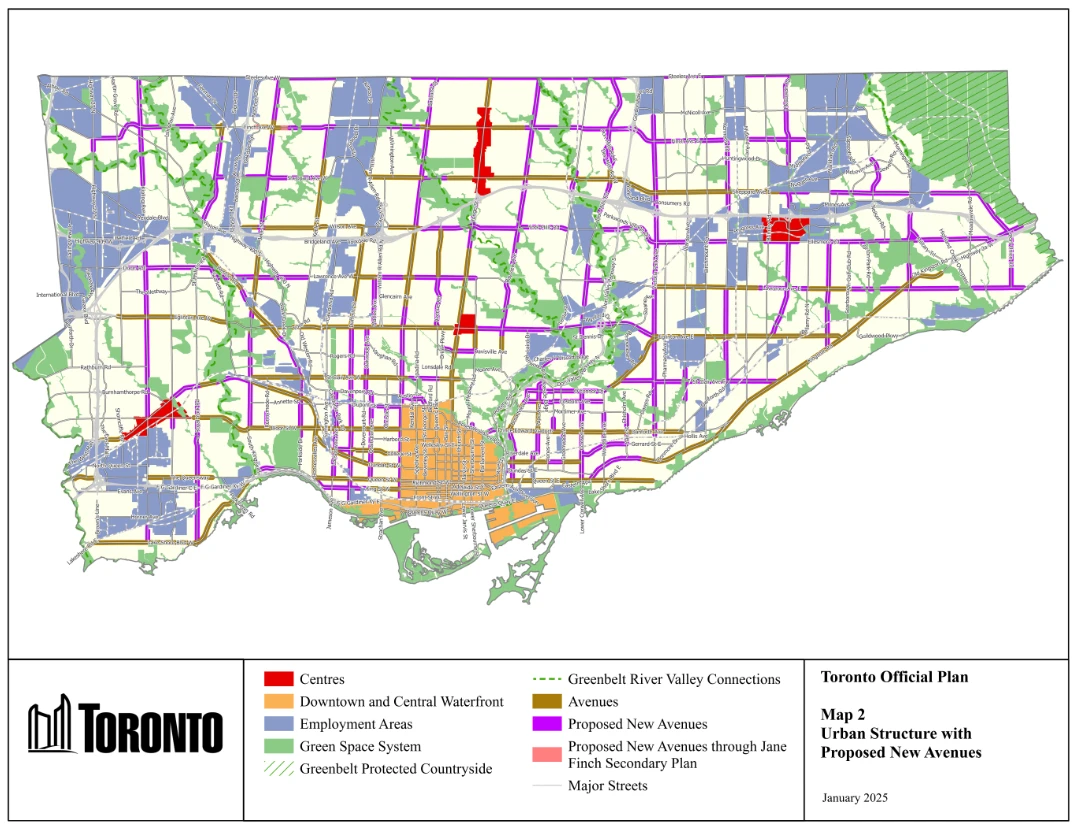
Toronto's Official Plan map showing Proposed New Avenues (in purple). Implementing by-laws that would allow mid-rise buildings as-of-right are rolling out in a multi-stage process and have been done for only 2 out of 25 city wards.
1. Finish What Was Started
The past term was filled with many good initiatives. But several of them have stalled, been delayed, or need more action to achieve the desired outcome. Council must make sure they aren't forgotten. It should commit to completing the following initiatives as soon as possible.
- Complete Avenues as-of-right Zoning studies faster, recover the drifting schedule
- Complete MTSA as-of-right Zoning
- Four storey 6-plexes city wide, increase lot coverage for multiplexes
- Monitor Major Streets construction and adjust zoning if new Major Streets construction isn’t producing much new housing
In the 2022-2026 Toronto City Council term, the Expanding Housing Options in Neighbourhoods (EHON) initiative, the Housing Action Plan 2022-2026, and the provincial approval of the Major Transit Station Areas (MTSA) Secondary Plans achieved significant improvements in Toronto’s housing policy. However, towards the end of the term several of these initiatives lost momentum or stopped entirely.
The 2025 Avenues Policy Review was a very good update to the Official Plan’s Avenues growth area. The Avenues are main streets and the policies are meant to encourage new mid-rise buildings along these corridors. The Policy Review significantly reduced the study requirements before new buildings could be constructed along Avenues, instead opting for a simple rule that heights up to the width of the road should be allowed as-of-right. It also significantly expanded the number of streets covered by the Avenues designation.
The remainder of the term was meant to be spent updating the Zoning By-Law to implement as-of-right permissions along the Avenues. The work plan for updating the zoning divided the work into three stages, planned to take nine months each, starting in June 2025. By the end of the term fifteen months later, only a quarter of Stage 1 had been completed, and the first zoning update for Wards 9 and 11 removed significant portions of the Avenues from the update for additional study at an unspecified future date.
The drift in the Avenues schedule must be halted, and the remaining zoning updates must be completed as soon as possible. Without the implementing zoning, new mid-rise buildings on the Avenues will continue to require expensive and slow rezoning applications, defeating much of the purpose of the Avenues policy updates.
In August 2025, the province of Ontario approved 120 of the City’s MTSA Secondary Plans. These plans were to add policies to the Official Plan to allow for higher density around subway and Light Rail Transit lines. In approving the MTSA plans, the province revised the plans to allow more density than the City of Toronto had originally proposed.
Toronto is required to implement the MTSA Secondary Plans into the Zoning By-law. The Planning Act protects these zoning updates from appeal to the Ontario Land Tribunal if they are passed within one year of the province’s approval. Toronto committed to implementing the zoning for MTSAs by summer of 2026. However, the end of the term passed without any hint of MTSA zoning updates, and the one year deadline came and went.
It is disappointing that the zoning updates for MTSAs will now be subject to Ontario Land Tribunal appeal, opening up the possibility for extended delays. However it is still very important that the zoning for MTSAs be implemented quickly. The MTSA Plans approved by the province would significantly increase the area where new buildings could be built as-of-right.
Multiplex approvals under the EHON initiative were one of the signature accomplishments of the past term. The original study in May 2023 allowed multiplexes up to four units with a height of 10.5 metres in all residentially zoned lands. This was followed up by a study of allowing sixplexes in Ward 23, Scarborough North in early 2025. In June 2025, an item to allow sixplexes City-wide was significantly revised down at City Council to limit the new permissions for sixplexes to only the Old City of Toronto.
In addition, the number of new multiplexes constructed since 2023 have been disappointingly low, with only a few hundred permitted in 2025. It is clear that if multiplexes are going to be a significant piece of new housing in Toronto that additional tweaks to the Zoning By-law are needed to make more multiplex projects viable.
Along with the expansion of sixplex permissions City-wide, additional revisions to the Zoning By-law, such as establishing higher lot coverages and reduced setbacks for multiplexes should be adopted.
The other major accomplishment of the EHON initiative in the previous term was the Major Streets Study, which allowed apartments up to 6 storeys and townhouses along the Major Streets defined in the Official Plan. The study was appealed to the Ontario Land Tribunal and only finally approved in September 2025. As a result, not many new housing projects have yet been started along Major Streets.
A program to track developments along Major Streets should be started to determine if the zoning updates implemented by the study have been successful. If the amount of new housing added along Major Streets is small, additional changes to the Zoning By-Law should be developed.
2. Speed Up Toronto Builds
The programs under the Toronto Builds framework have announced dozens of projects on City owned land over the past two terms. However many of these have failed to get off the ground. Many more are endlessly delayed. Housing Now has still not resulted in any new affordable units after 7 years. Council needs to focus on speeding up and lowering the cost of city run housing projects.
- Remove extra requirements on city lead projects
- Zone for more than is needed in case of revision
- Reduce iterations on designs
- Fund/loan projects that are stalled
- Finish Housing Now buildings
- Redevelop Green P lots
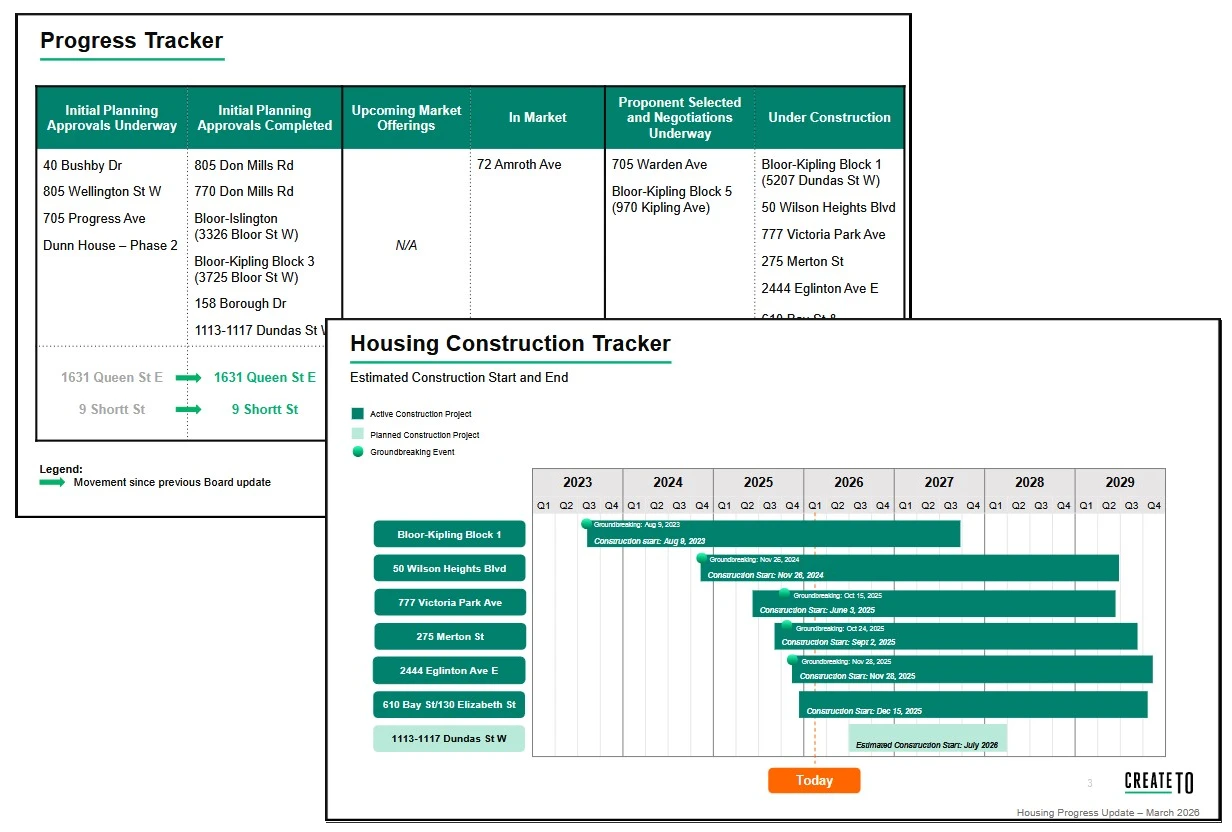
During the 2022-2026 council term, many separate programs to build affordable housing on City owned land, such as the Housing Now program, were consolidated under the Toronto Builds framework. While this standardized many of the aspects of Toronto’s affordable housing programs, one thing has remained constant. The City’s affordable housing is built slowly. Despite beginning in 2019, zero units of affordable housing have been built on the Housing Now sites.
Toronto must speed up its construction of housing on City owned land. The slow delivery speed is not caused by a single factor. There are multiple overlapping factors which slow down the projects.
Toronto Builds projects are often subject to requirements and additional processes beyond the already slow development application process. For example, at a supportive housing development at 53 Strachan Avenue, the city decided to heritage designate its own project mere months before applying for a Zoning By-law amendment, which then required an application to alter a heritage protected building, resulting in additional work. It then decided to delay zoning approval for half the site to allow for additional community negotiation to move a community garden.
The Toronto Builds sites have often had to go through multiple rezoning applications. The project at 970 Kipling was originally rezoned in 2021 using a site specific zoning by-law amendment that specified height limits and non-residential gross floor area. It had to be rezoned again in 2026 to allow for taller buildings to make the project financing feasible. This second rezoning was a waste of time. The City should be proactively zoning its Toronto Builds sites to be more permissive than it thinks it needs so that if conditions change, time and money doesn’t need to be spent on more paperwork.
City owned sites have also been treated as an opportunity for never ending design revisions, with the result that even completed plans are subject to ongoing negotiation and revision. Take for example the Housing Now site at 50 Wilson Heights Boulevard. Following its rezonings in 2020, it was redesigned and needed another rezoning in 2024. Then that decision was re-opened a year later to include yet further design iterations.
The COVID-19 pandemic and subsequent inflation and interest rate increases introduced significant funding issues into the Housing Now projects which have added additional delays. For example, the project at 2444 Eglinton East has required significant additional negotiation between the City and its development partners following the partners worsening financial situation. Dozens of sites in the Toronto Builds 3-year work plan are trying to identify funding and financing partners. The City of Toronto has offered incentives to a number of housing projects. It should expand direct incentives and loans to help unstick its Toronto Builds projects.
Beyond the items we have mentioned, the Toronto Builds program needs dedicated attention to speed up delivery of affordable housing. At the current rate it is likely that the majority of the original Housing Now sites will not be complete more than a decade after the start of the program. The ambitious targets set by the Toronto Builds program will not be achieved if it takes a decade or more to build single buildings.
Lastly, while many sites were added to the Toronto Builds program in the 2022-2026 term, there remain significant amounts of City-owned land which could be used for housing. In particular, Green P sites, especially those near transit, represent a significant opportunity which should be added to the Toronto Builds program.
3. Tax Fairly and Sustainably
For the past two terms, taxes and fees on new housing grew dramatically. This contributed to the collapse in new housing starts. It was neither fair or economically sustainable. Despite a temporary decrease in Development Charges, paid for by other levels of government, taxes and fees on housing will need to be permanently reduced to avoid these problems happening again.
- Lower development charges permanently after the temporary reduction
- Reduce other development fees
- Review fees for Toronto Water and Hydro hookups
- Study parking levies on commercial surface parking lots
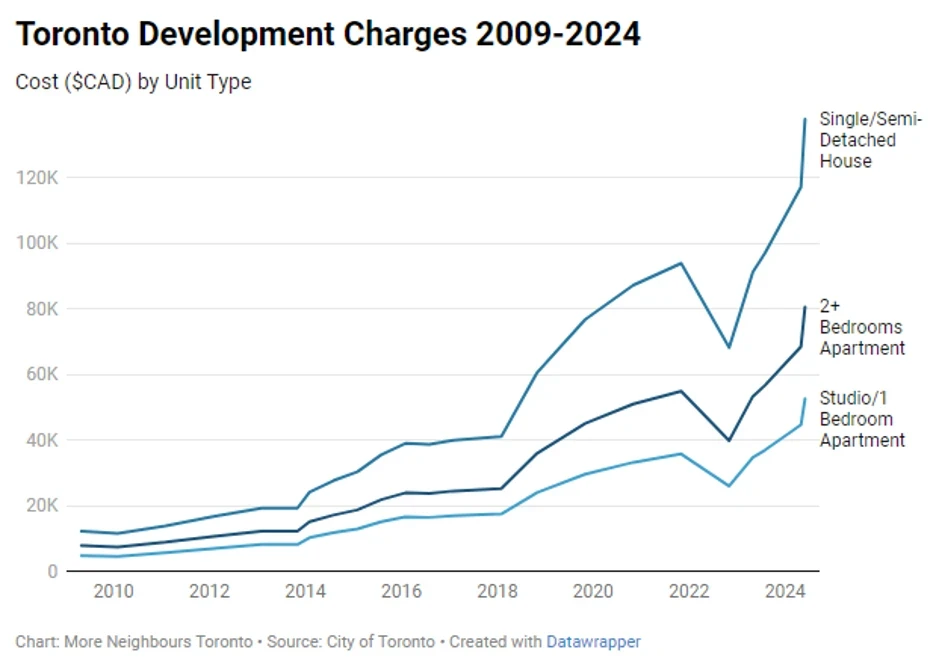
The City of Toronto has been increasing development charges significantly, and now has some of the highest development charges in the country. As shown in the chart below, development charges are now tens of thousands, sometimes hundreds of thousands of dollars per new housing unit, equivalent to decades of property taxes which must be paid upfront. These charges make it more expensive to construct new housing, which decreases the financial feasibility of new developments, reducing housing supply. A summary of the economic research on development charges prepared by the CMHC has shown that development charges directly increase not only the price of new housing, but also increase the price of existing housing as well.
Put simply, Toronto’s development charges are economically destructive and unfair. They concentrate taxes on young Torontonians and people moving to our city. They have been a major cause in the significant drop of housing starts in Toronto. This is turn have caused development charge revenue to the City to collapse. The current development charge rates are not economically sustainable.
The federal and provincial governments have been trying to get Toronto to reduce its development charges. At the end of the past term, a deal was announced for Toronto to temporarily reduce its development charges by 40-60% in exchange for $1.5 Billion in funding from the Ontario and Canada governments. This is a welcomed measure. However, in the next term the City should permanently reduce development charges to a fair level which is less harmful to new housing construction and helps reduce the price of housing in the long term.
Beyond development charges there are several other taxes and fees that raise the cost of new housing, especially missing middle housing.
Along with the development charges, there are a host of other fees which can add hundreds of thousands of dollars in costs to a new housing development. These fees are nominally meant to correspond to staff costs to review the development application, but as with development charges, the fees are collected in an economically inefficient way with large downsides.
The fees directly raise the cost to construct housing and so reduce the supply of new housing and raise housing prices for everyone. The fee structure is also designed such that there are large base fees, which makes the cost disproportionately higher for smaller development applications, including much of the missing middle housing that Toronto is trying to encourage. These fees must be reduced and a more fair and less harmful way of raising the money must be found.
The design of water and hydro connection fees also disproportionately harms missing middle housing. Developments with more than 5 units must follow a significantly more expensive Industrial, Commercial, and Institutional process. Similarly, more expensive hydro connection processes begin at 6 units. These processes should be reviewed to ensure they are not unnecessarily treating smaller developments in the same way as large towers and disproportionately increasing costs on missing middle housing.
To offset the reduction in development charges and other housing fees, Toronto should explore ways to raise revenue tools that make new housing more likely to be built. The city should study a commercial parking levy, which in addition to environmental benefits would raise the cost of under-used land and encourage conversion to housing.
4. Plan for the Future
Municipal and provincial actions over the past few years have allowed more housing in the City of Toronto. It remains to be seen whether these will be enough to stop housing prices from rising. Even if they are, planning for future generations is an ongoing responsibility for every Ward. We have seen the terrible consequences of neglecting this responsibility. Bill 98 will require significant changes to the Official Plan. This presents a unique opportunity to reshape housing policy in Toronto. Council should write a more flexible and more fair Official Plan and continue to update zoning to allow more housing.
- Start an overhaul of the Official Plan
- Write a new Housing Action Plan for 2026-2030
- Develop tighter criteria for Heritage Conservation Districts
- Modernize Zoning (form based zoning)
- Consolidate and limit Secondary Plans and SASPs
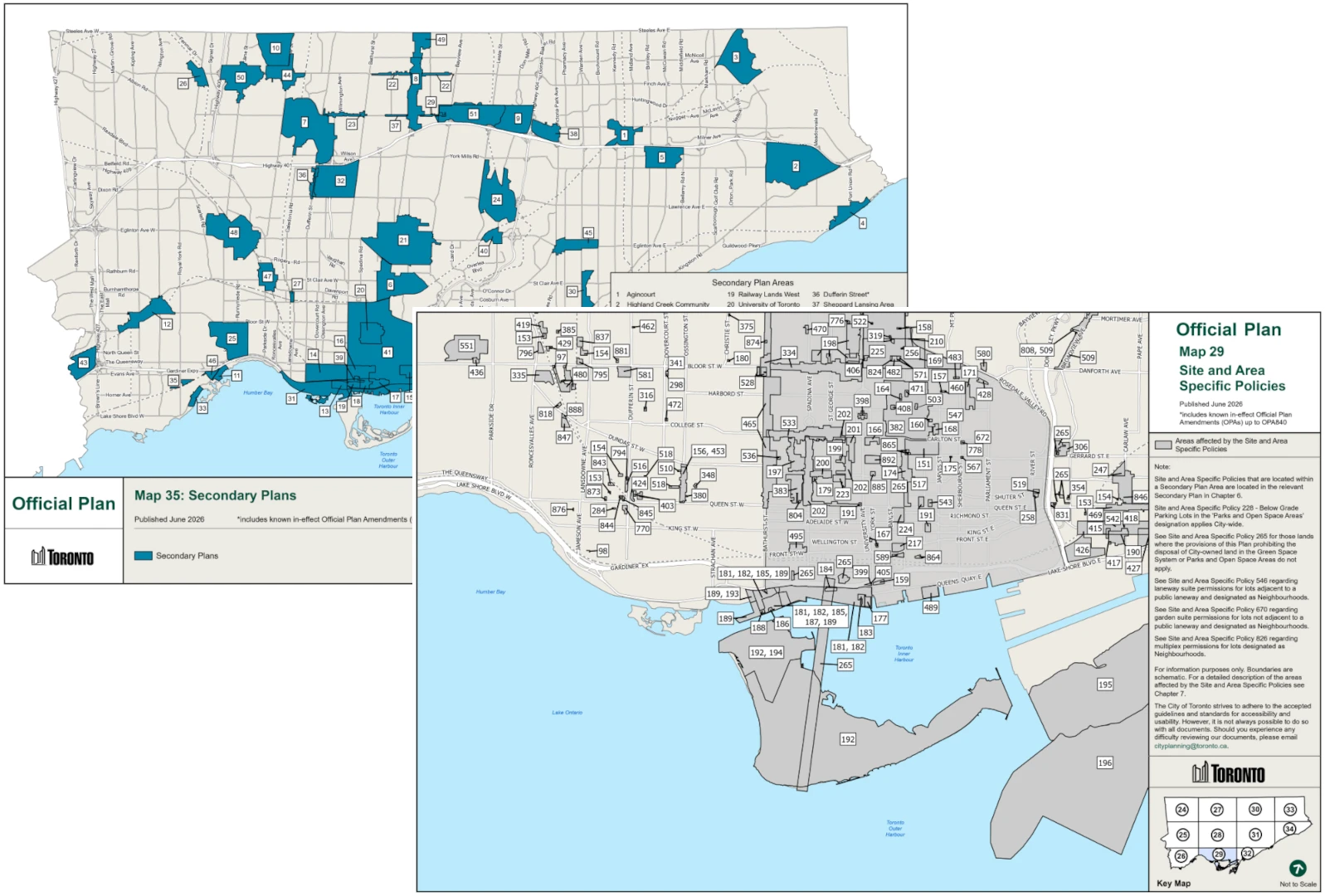
Toronto's Official Plan is a multi-layered strata of overlapping and sometimes contradictory regulations, constraints, and exemptions that can differ block-by-block. It's time to simplify and make the Official Plan consistent.
The 2022-2026 council term saw the largest effort to expand permissions in the City of Toronto in decades. This was bolstered by provincial actions to significantly expand the ambition of the Major Transit Station Area plans. What is not yet known is whether these changes will be sufficient to stop the long term rise of housing prices and rents in Toronto.
The past few years have seen flat housing prices in Toronto, and recent rental market trends have shown some modest decreases which partially offset the rapid increases seen following the COVID-19 pandemic. This aligns with national trends caused by weakening housing demand due to higher interest rates and the large reductions in temporary foreign worker permissions by the federal government. It remains to be seen what will happen when demand for new housing returns.
Regardless, it is the responsibility of Toronto City Council to prepare for future generations. The current Official Plan, first approved by the City in 2002 is not up to the task. The planning and development review process established by the plan has consistently failed to produce enough housing for an entire generation, resulting in the high housing prices and rents seen in the City today. It has also unfairly concentrated growth to small areas, with some wards struggling to keep up with infrastructure while many wards seeing flat or negative population growth.
With the additions of the Multiplex Study, the Major Streets Study, neighbourhood retail, and Major Transit Station areas, the Neighbourhoods and Growth Areas policies of the current Official Plan are becoming increasingly incoherent. City Planning initiatives are becoming increasingly stymied by stale Secondary Plans written decades ago. The Official Plan is beginning to buckle under the weight of the decades of policy cruft that has built up.
The recently passed Bill 98 will require a significant overhaul of the Official Plan by 2030. The initial response from the City has been to take a wait-and-see approach to Bill 98 while the regulations associated with the bill are written. The hope appears to be that the existing Official Plan can be tweaked to fit the new requirements. This is wishful thinking, and waiting risks leaving the necessary changes to the last minute. The existing Official Plan is not worth preserving and City Council should immediately begin the process to overhaul it, make it consistent with Bill 98, and outline a new vision that is up to the task of housing the next generation.
Along with the overhaul of the Official Plan, City Council should prepare a new Housing Action Plan for the 2026-2030 term. The previous Housing Action Plan 2022-2026, which guided the agenda of the Planning and Housing Committee during the previous term, was sometimes frustrating and often delayed. But it still achieved significantly more reform than any other Planning and Housing Committee this century. Laying out priorities for the City Planning division to focus on during the term proved to be an effective tool and should be repeated.
The next big long-term challenge for the Planning and Housing Committee is reforming the City’s heritage policies. In particular, Heritage Conservation Districts have increasingly become reactive tools for neighbourhoods, often wealthy neighbourhoods, to veto the gentle density of missing middle housing approved by the EHON initiative with little consideration for the historical importance or architectural significance of the houses being protected. The Heritage Preservation Board has also been increasingly protecting buildings which may be redeveloped rather than trying to identify the buildings with the most historical or architectural significance. The City’s heritage policies must be reconsidered so that they are focused on identifying and preserving buildings of significance rather than being used as an alternate development approval process.
One of the items from the Housing Action Plan 2022-2026 which was unsuccessful was the Zoning By-law Simplification & Modernization program for residential zones. Phase 1 of that program made minor tweaks, and Phase 2 has a very modest scope which may be abandoned. Toronto’s existing zoning is highly complex, with standards set lot-by-lot and an outdated focus on preventing certain residential uses rather than focusing on the size and scale of buildings. This program should have been an opportunity to move towards a modern form based zoning with clear standards. City Council should revisit this program and work towards the modern residential zoning seen in other Canadian cities like Edmonton.
Finally, Toronto faces a long term problem with the dozens of Secondary Plans and hundreds of Site and Area Specific Policies, some of which are shown in the maps below. These plans take precedence over the policies of the Official Plan. They can also go decades without being updated as Toronto evolves. There is no process to consolidate or remove outdated plans. This causes them to have a ratcheting effect where new plans only ever get added and supersede general policy, and so only ever tighten restrictions over time. The next City Council should instruct City Planning to create a process to consolidate and simplify these plans.